
Table of Contents
- Understanding the Bosch Benchmark Series
- Diving into the Bosch 800 Series
- Direct Comparison: bosch benchmark vs 800
- Performance Metrics in bosch benchmark vs 800
- Design & Aesthetic Considerations
- Installation, Space Requirements, and Compatibility
- Energy Efficiency and Sustainability
- Quick Home Décor Tips
- Common Mistakes When Choosing a Dishwasher
- Frequently Asked Questions
- Conclusion
Bosch Benchmark vs 800: Which Dishwasher Fits Your Kitchen?
When it comes to outfitting a modern kitchen, the dishwasher is often the unsung hero that silently lifts the daily load. Among the many options on the market, Bosch’s Benchmark and 800 series stand out for their reputation of quiet operation, efficient cleaning, and sleek aesthetics. But which of these two families truly aligns with your lifestyle, design taste, and budget? In this comprehensive guide we’ll unpack the strengths and compromises of each, walk through side‑by‑side performance data, and give you actionable advice so you can choose the model that feels tailor‑made for your home.
Whether you’re renovating a compact apartment, upgrading a family‑size kitchen, or simply looking for that extra edge of convenience, understanding the nuances between the Bosch Benchmark and 800 lines will help you avoid costly mistakes. By the end of this article, you’ll have a clear picture of the technology, design language, and sustainability credentials that differentiate the two, empowering you to make a confident purchase.
Understanding the Bosch Benchmark Series
The Benchmark series represents Bosch’s premium tier, positioned as the pinnacle of dishwasher engineering. Built with a focus on ultra‑quiet performance, the Benchmark models typically operate at 42 dB(A) or lower, making them ideal for open‑plan homes where the kitchen is adjacent to living and dining areas. Key features include the patented “CrystalDry” technology, which uses a zeolite mineral to absorb moisture and generate heat, delivering dryer dishes without a heated dry cycle.
Beyond the drying system, the Benchmark line offers a flexible “RackMatic” interior that can be adjusted in three positions, allowing you to accommodate tall pots, bakeware, and delicate glassware with ease. The series also boasts a “TimeLight” projection that casts the remaining cycle time onto the floor, a subtle yet handy feature for busy households. In terms of connectivity, many Benchmark models integrate with Home Connect, letting you start, stop, or monitor the machine from a smartphone.
Diving into the Bosch 800 Series

The Bosch 800 series sits just a step below the Benchmark tier, yet it still delivers impressive performance that satisfies most homeowners. With noise levels ranging from 44 to 48 dB(A), the 800 models are quiet enough for most open‑concept spaces while generally being more budget‑friendly than the Benchmark. The 800 line introduces “InfoLight,” a subtle indicator that glows when the door is open, and “RackSelect,” an adjustable upper rack system that offers three height settings.
Cleaning power in the 800 series is driven by the “PrecisionWash” system, which employs powerful spray arms and a dedicated sensor to tailor water pressure based on load size. While it lacks the zeolite‑based drying of the Benchmark, the 800 models include “EcoSilence Drive,” a brushless motor that reduces energy consumption and extends the appliance’s lifespan. Like the Benchmark, many 800 models are compatible with Home Connect, providing remote control options.
Direct Comparison: bosch benchmark vs 800

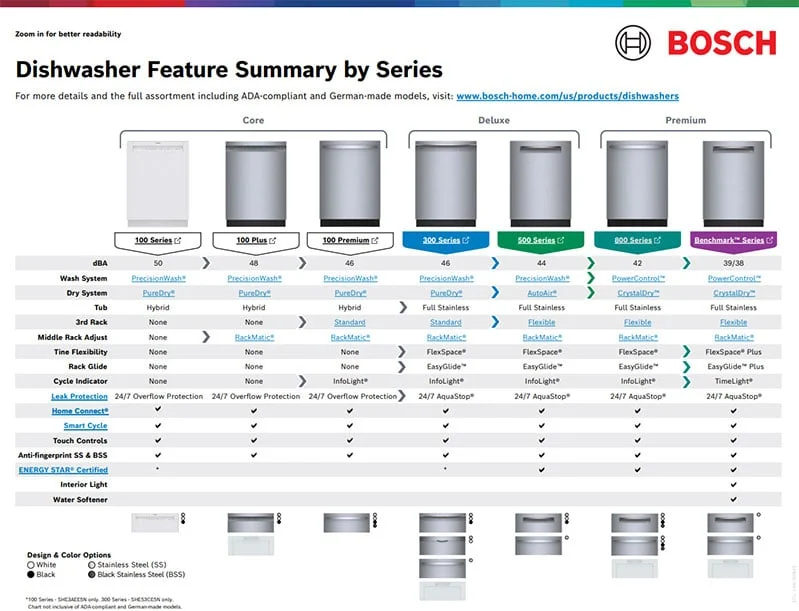
Now that we’ve explored each series individually, let’s place them side by side. The following table highlights the most frequently asked aspects of the bosch benchmark vs 800 debate, helping you see at a glance where the differences truly matter.
Performance Metrics in bosch benchmark vs 800
- Noise Level: Benchmark – 42 dB(A) or lower; 800 – 44‑48 dB(A).
- Drying Technology: Benchmark – CrystalDry (zeolite); 800 – AutoDry with condensation.
- Energy Efficiency: Both series qualify for ENERGY STAR, but the Benchmark typically achieves a slightly higher SEER rating due to the zeolite system.
- Cycle Options: Benchmark – 9‑12 programs; 800 – 6‑8 programs, including “Speed30” and “AutoEco.
- Flexibility: Benchmark – RackMatic 3‑position; 800 – RackSelect 3‑position plus a “Silverware Tray” option.
- Connectivity: Both support Home Connect; Benchmark adds “VoiceControl” via Amazon Alexa and Google Assistant.
When you examine the bosch benchmark vs 800 data, the most noticeable gaps appear in drying performance and absolute quietness. If you host dinner parties frequently and need dishes to emerge spotless without a final heated dry, the Benchmark’s CrystalDry gives it an edge. Conversely, for everyday families who value reliability and a lower price point, the 800 series provides more than enough cleaning power.
Design & Aesthetic Considerations
Both series share Bosch’s signature stainless‑steel front panels, but there are subtle design cues that can influence the overall look of your kitchen. The Benchmark line often features a brushed stainless finish with hidden controls that illuminate only when touched, creating a minimalist appearance that blends seamlessly with high‑end cabinetry. The 800 series, while still sleek, may include a more traditional knob or touch‑pad layout that can be slightly more visible.
If you’re curating a cohesive interior design, think about how the dishwasher’s visual language aligns with other appliances. For example, pairing a Benchmark model with a matching Bosch oven can reinforce a “premium appliance suite” feel. On the other hand, the 800 series works well in contemporary or transitional kitchens where a subtle contrast between appliances adds visual interest.
For additional kitchen styling inspiration, check out our guide on neutral kitchen interior ideas. The article showcases how understated appliance finishes can become a backdrop for bold countertop materials or colorful backsplashes.
Installation, Space Requirements, and Compatibility
Both the Benchmark and 800 dishwashers are designed to fit standard 24‑inch (60 cm) cabinet openings, making them interchangeable in most remodel scenarios. However, the Benchmark models often come with a slightly deeper tub to accommodate larger pots, which may require a minor adjustment to the surrounding cabinetry. Before committing, measure the vertical clearance; some Benchmark units need an extra inch of headroom for the top rack’s highest position.
Another practical factor in the bosch benchmark vs 800 debate is the water hardness compatibility. The Benchmark’s zeolite drying system is less sensitive to hard water, reducing mineral buildup over time. The 800 series, while equipped with a built‑in water softening option, may benefit from a supplemental external softener in regions with very hard water.
Installation tips:
- Check the anti‑vibration mount points; the Benchmark’s EcoSilence Drive is heavier and may need reinforced brackets.
- Ensure the electrical outlet provides a dedicated 120 V circuit with a ground fault circuit interrupter (GFCI) for safety.
- Plan the drain hose length to avoid kinks that could affect performance in either series.
Energy Efficiency and Sustainability
In an era where homeowners prioritize green living, the energy profile of a dishwasher matters. Both the bosch benchmark vs 800 families are ENERGY STAR certified, but the Benchmark’s zeolite drying reduces the need for a heated dry cycle, saving roughly 10‑15 % more electricity per load. Additionally, the Benchmark’s EcoSilence Drive motor uses brushless technology, which translates into longer service life and lower maintenance.
The 800 series compensates with its “EcoSilence Drive” motor and “AutoEco” cycle, which adapts water temperature and pressure based on load sensors. For households that run mostly light loads, the 800’s “Half Load” option can cut water usage by up to 50 % compared to a full‑load cycle.
If you’re interested in broader home sustainability, explore our article on decorating a ranch‑style home where we discuss integrating energy‑efficient appliances into a cohesive design narrative.
Quick Home Décor Tips
- Use matching stainless‑steel accessories (pot racks, utensil holders) to create a unified look with your dishwasher.
- In open‑plan kitchens, choose the quieter bosch benchmark vs 800 model (Benchmark if silence is a priority).
- Install under‑cabinet lighting that highlights the dishwasher’s sleek front when the door is open.
Common Mistakes When Choosing a Dishwasher
Even seasoned homeowners can slip up when evaluating the bosch benchmark vs 800 options. Below are pitfalls to avoid:
- Focusing solely on price: The initial cost difference may seem small, but long‑term energy savings from the Benchmark’s zeolite drying can offset the price gap.
- Ignoring kitchen traffic patterns: In homes with a living room adjacent to the kitchen, the quieter Benchmark model can prevent noise complaints.
- Overlooking rack flexibility: If you frequently wash large baking sheets, the Benchmark’s deeper tub and adjustable rack can be a game‑changer.
Frequently Asked Questions
Which series is quieter, bosch benchmark or 800?
The Benchmark series typically runs at 42 dB(A) or lower, making it quieter than the 800 series, which operates between 44‑48 dB(A). If you have an open‑plan layout, the Benchmark’s lower decibel level may be preferable.
Do both series support smart home integration?
Yes. Both the Benchmark and 800 models are compatible with Bosch’s Home Connect platform, allowing remote control via smartphone. The Benchmark adds native voice‑control support for Alexa and Google Assistant.
Is the zeolite drying system in the Benchmark worth the extra cost?
For households that prioritize pristine, dry dishes without a final heated dry, the zeolite system offers superior results and saves energy. If you mainly wash lightly soiled items, the 800’s AutoDry may be sufficient.
Can I install a Benchmark dishwasher in a space originally designed for an 800?
Generally yes, as both fit standard 24‑inch openings. However, double‑check the vertical clearance, as Benchmark models can be slightly deeper.
How do I maintain my dishwasher to keep it performing well?
Regularly run a cleaning cycle with a dishwasher‑safe cleanser, wipe the door gasket, and clean the spray arms. For hard water areas, consider using a rinse‑aid to prevent mineral buildup, especially on 800 models.
Are there any design differences that affect how the dishwasher looks in a modern kitchen?
The Benchmark often features a hidden touch control panel and a brushed stainless finish, creating a more seamless appearance. The 800 series may display a visible control panel, which can be a design statement in its own right.
Conclusion
Choosing between the Bosch Benchmark and 800 series ultimately hinges on your priorities. If ultra‑quiet operation, cutting‑edge drying, and a premium aesthetic are top of your list, the bosch benchmark vs 800 comparison tilts in favor of the Benchmark. If you seek solid performance, flexible loading, and a more modest price tag, the 800 series delivers reliable results without sacrificing the core qualities Bosch is known for. Consider the size of your kitchen, the typical load size, and your commitment to energy efficiency. By aligning these factors with the strengths highlighted above, you’ll select a dishwasher that not only cleans effectively but also enhances the overall harmony of your modern home.